 Martin Najat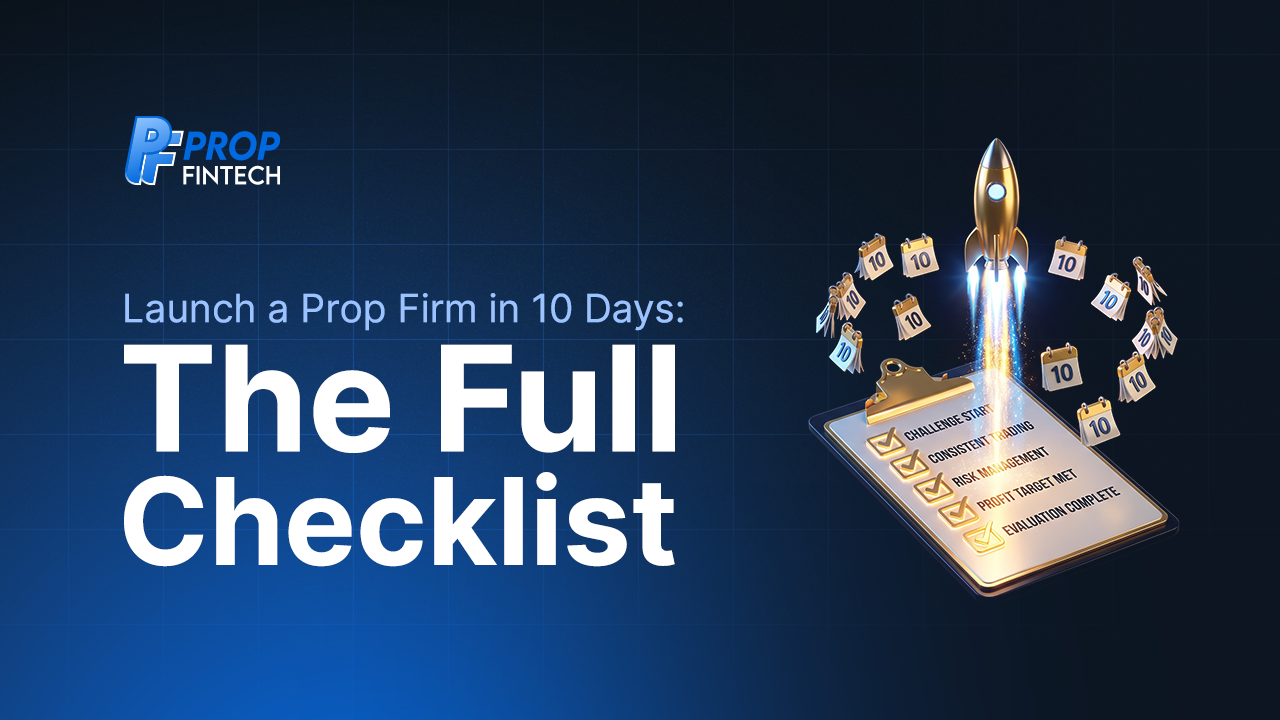
You can launch a prop firm in 10 days. What the number leaves out is that the ten days do not start when you sign. They start when your entity exists, your terms are drafted and your merchant account is underwritten, because none of those run on our clock.
Ten days is everything related to us, which is the technology side. Anything that is a legal setup or a payment provider is third party, so it sits outside our control. That distinction is the whole post, because a build that finishes on day ten and cannot take a payment has not launched anything.
So this is two checklists running in parallel. Ours, which is the ten day build we publish. And yours, which is what actually sets the date. If the model and jurisdiction decisions are still open, the full launch sequence for prop firm founders comes before either of them.
Before you can launch a prop firm in 10 days
Day one is a scoping call, not a starting gun. These are the things to have in hand or genuinely in flight before it, with what happens to your date for each one that is missing.
- A legal entity that can contract with traders and appoint providers. Missing: nothing else can start, because the merchant account, the platform account and the KYC account are all opened in the entity’s name.
- Terms, trader agreement and disclosures with your counsel. In flight is fine. Missing entirely: you can build, but you cannot open, and the wording usually forces rule changes late, which is the expensive kind.
- A merchant account applied for, ideally with two providers. Missing: this becomes your launch date. See the next section, because it is the single most common reason a finished build sits idle.
- A written rulebook. Targets, drawdown definition, consistency rule, prohibited strategies, payout policy. Missing: the Configure phase has nothing to configure against, and we will be asking you rule questions instead of building.
- A platform decision. Which trading platform, and an account with them. Missing: the Integrate phase stalls on its first dependency.
- Domain, DNS access and brand assets. Missing: you go live on somebody else’s subdomain, which is not a launch you want to advertise.
- Named owners for risk monitoring, trader support, payouts, KYC review and disputes. Missing: the build hands over to nobody. If you have not decided whether to hire or buy that cover, price both sides properly first, because the answer changes what you need ready on day ten.
None of those are things we can do for you, and every one of them is cheap to start early and expensive to start late.
Your track, and why the payment provider sets the date
Three items sit on your side: the entity, the legal paperwork, and the payment provider. The first two are mostly a matter of starting them, since a registry and a law firm both move at a predictable pace once instructed. The third is the variable.
Getting a merchant account can take as little as one week, and it can run on for a month or two depending on which provider you go with. That range is our own experience across the firms we work with, and it is the widest variable in any launch we have been part of. Underwriting is where the spread comes from: a brand new entity with no processing history, a model the desk has not seen before, documents arriving in instalments, or a jurisdiction mismatch between the entity, the directors and the target market.
Which is why the sequencing advice is blunt. Apply before you commission the technology, not after. Apply to two providers rather than one, and treat the second as insurance rather than waste. Ask the underwriter for the full document list on day one of that process and send it complete.
The build does not wait for this. It runs in parallel, and it finishes. What waits is the ability to take a single evaluation fee, which means the payment provider, not the platform, is usually what decides when you open.
The ten day build, phase by phase
Four phases, exactly as we publish them: Scope on day 1, Configure across days 2 to 4, Integrate across days 5 to 8, Launch across days 9 to 10. Custom integrations, unusual rule sets or a migration from an existing provider can extend that, and we say so before you sign rather than after. Inside those boundaries the order can flex around what you have ready, which is why the table below is organised by dependency rather than by hour.
Day 1 is Scope: your model, jurisdiction and existing setup, and you leave with a written plan and a fixed price. Days 2 to 4 are Configure: programs, risk rules, payout policy and branding, all set against your rulebook. Days 5 to 8 are Integrate: trading platform, payments, KYC and email connected, then tested end to end with real flows. Days 9 to 10 are Launch: live on your domain, with your team trained and monitoring in place from hour one.
The fourth column is the one to read twice.
| Stage | What we do | What we need from you | What it blocks if it is missing |
|---|---|---|---|
| Scope, day 1 | Review your model, jurisdiction and existing setup, then hand over a written plan and a fixed price | Decisions on programs, price points, target markets and payout policy | Everything. Nothing gets configured against an undecided model |
| Rulebook intake, day 1 | Turn your rules into enforceable logic and flag every ambiguity back to you | The written rulebook, with drawdown and consistency defined | Programs, the risk engine, the payout gate |
| Branding and domain, days 2 to 4 | Style both portals and point them at your domain | Logo files, colours, domain and DNS access | Going live under your own brand |
| Programs, days 2 to 4 | Build Evaluation Design against your rulebook: targets, drawdown model, consistency, prohibited strategies | Sign off on the exact wording of each rule | The risk engine, and any trader registration |
| Risk rules and payout policy, days 2 to 4 | Set breach detection and the approval workflow in Payouts Management to your policy | Your escalation decisions, so we know who signs off what | Every held payout you will ever process |
| Trading platform, days 5 to 8 | Connect the platform, provision accounts, verify live trade data | Your platform account and credentials | Every stage after it. No platform, no evaluation |
| Payments, days 5 to 8 | Connect checkout and cashier, then test with real flows | An underwritten merchant account in your entity’s name | Taking money. This is the one that stops launches |
| KYC, days 5 to 8 | Connect verification into onboarding and into the payout gate | A KYC provider account in your entity’s name | Funding anybody, and clearing any payout |
| Email and attribution, days 5 to 8 | Connect transactional email and attribution, tested end to end | Sending domain, ad account access, tracking decisions | Knowing which spend produced a funded trader |
| Affiliate Portal and Automation, days 5 to 8 | Referral links, commission structure, onboarding triggers, tagging and reporting | Your commission structure and partner terms | Partner recruitment, though not the launch itself |
| End to end testing, days 5 to 8 | Run the real flows: a payment, a deliberate breach, a payout through hold and approval, a KYC rejection | Your team present, so they see the failures too | Opening with any confidence |
| Launch and training, days 9 to 10 | Go live on your domain, train your team on the Admin Portal, monitoring in place from hour one | Named owners for risk, support, payouts and disputes | Hour one cover, which is when your first traders arrive |
What gets tested before you open
Most launch checklists stop at connected. Connected is not tested. Five things should be made to happen deliberately, on real flows, before a trader ever sees the site.
A real payment, end to end. Not a sandbox transaction. A live card or transfer through your own merchant account, into your own ledger, with the reconciliation checked and a refund processed back out.
A rule breach, fired on purpose. Open a position that breaks a hard limit and watch the system decide: the trigger fires, the account is marked, and the evidence behind it is stored where a reviewer can find it later. If the breach needs a human to notice it, you do not have enforcement, you have monitoring. The wider question of which decisions the system makes alone and which need a named person is covered in our guide to how risk actually runs day to day, and day nine is a bad time to discover you never answered it.
A payout through both paths. One that clears normally, and one that gets held with a reason attached, escalated, reviewed and then released by somebody other than the person who held it. Watch what the trader sees at each step, because that wording is the product.
A KYC rejection. Everybody tests the happy path. Test a document that fails, and check what the applicant is told, who reviews it, and how they get back on track.
Your admin team, unaided. Sit down and watch them use the Admin Portal without us in the room. Every question they ask is a gap in the handover, and the handover is what you are actually buying in the last two days.
Go live day, and the first forty eight hours
Go live is deliberately dull. Your domain resolves to your portals, the first registrations come in, the first evaluation fees process, and monitoring is already running rather than being switched on afterwards.
What to watch in the first forty eight hours, in this order. Payments, because a declined checkout looks like a broken site to a buyer and you will not hear about most of them. Registration and KYC completion, since a drop off between paying and verifying is usually a flow problem rather than a demand problem. The first breaches, because early breach behaviour tells you whether your limits read the way you intended. Support volume and the questions being asked, since repeated questions are almost always a wording problem in your own rules. And your own inbox, because on day one everything still escalates to you.
Do not change a rule in the first forty eight hours unless it is plainly wrong. Traders who have already paid are trading under what you published.
What is not done on day ten
Four things, and being honest about them is the difference between a launch and a handover.
Operations cover is not rostered by us. The build hands over to your people, across a trading week that runs from Sunday evening to Friday evening rather than an office day. If that rota does not exist yet, either it gets built or you buy it as a managed operational team for prop firms.
Marketing is not live and attributed. The tracking is connected on our side, but campaigns, creative and the discipline of measuring spend against funded traders rather than clicks is work that starts on day eleven.
Abuse detection is connected but not tuned to your book. Cross account detection needs your own traders’ behaviour to calibrate against, which means the first weeks are where thresholds get set with real patterns rather than assumptions.
And your first payout window has not happened. That is the day your firm gets tested in public: holds explained, evidence attached, decisions defended, money out on the schedule you published. Everything before it is preparation.
If you want the two tracks mapped against your own situation, including what your merchant account is likely to do to your date, book a scoping call and bring your rulebook and your entity status. The founders who open on time are the ones who started their own track first.